

When was the last time someone told you “don’t ever give up,” and it actually helped?
Not “don’t give up on your marriage during a rough patch.” Not “don’t give up on your kid.” I mean the version we hear in business — the one that gets shouted from a stage, as if constant repetition of anything will somehow produce good results. The one that implies quitting is always weakness and persistence is always virtue.
Here’s the better question: what if you have great focus, real resilience, and the outcomes still aren’t showing up? Does the advice still apply?
THE QUOTE
“Winners never quit” may actually be terrible advice.
— Steven Levitt, University of Chicago economist and co-author of Freakonomics
Steven Levitt — the University of Chicago economist behind Freakonomics — put it more bluntly than most business coaches ever would. His conclusion: the old line that “winners never quit” may actually be terrible advice.
That’s not a motivational speaker trying to sound edgy. That’s an economist who ran an actual experiment on the question.
THE STORY
In 2013, Levitt and fellow economist John List built a website where people facing genuinely hard decisions — quit the job, end the relationship, move cities, have the baby — could flip a digital coin to decide. Not because a coin is wise, but because people paralyzed on the fence were, by definition, evenly split between two reasonable paths. Over 20,000 people used it.
Levitt followed up two months later, and again at six months. The finding surprised him: people who flipped heads — the side telling them to make a change, which sometimes including quitting something — reported being noticeably happier than the people who flipped tails and stayed the course. People pushed toward change by the coin followed through more often than those told to stay put, and they didn’t regret it. They said, months later, they’d make the same call again.
Is it a bit concerning that people would delegate some major life decisions to a coin flip? For sure. Keep reading to get “The Point”, and I will give you a better method and some questions to get intentional on this.
Now bring that back to real estate, or coaching, or any business built on daily discipline. Picture the agent grinding away at a lead-gen strategy that hasn’t produced in eight months. Or the team leader still running a training program nobody’s showing up for. The “never quit” crowd tells them to grind harder. Levitt’s data suggests something less comfortable: maybe the grind isn’t the problem. Maybe the strategy is. Maybe a skill needs to be developed. Maybe what they are doing doesn’t align with who they are.
THE HYPERBOLE
I gave up smoking nearly ten years ago. If “never give up” were universally true, I’d still be doing it — badly, expensively, and while wheezing up a flight of stairs. Setting a bad example for my kids. Turns out “never give up” was excellent advice for my marriage and absolutely terrible advice for my Marlboro Ultra Lights habit. You know, because Ultra Lights were a lesser evil.
Context, of course, does most of the heavy lifting in our famous phrase.
THE RESEARCH
This isn’t just a coin-flip curiosity. Business author Seth Godin built an entire framework around the same idea in his book The Dip. His core distinction: there’s a difference between a Dip — a temporary, painful stretch that gets better if you push through — and a Cul-de-Sac, a dead end that no amount of grit will turn into progress. As Godin puts it, “winners quit fast, quit often, and quit without guilt” — until they find the one thing worth sticking with.
Godin’s real point isn’t “quit more.” It’s “quit on purpose.” He separates strategic quitting — a deliberate decision based on where your effort is actually going to pay off — from reactive quitting, which is what most people do: they stick with things too long out of habit or pride, or dare I say comfort. Then they bail at the exact moment things get painful, which is usually the worst possible time to fold. Godin calls this “coping” — muddling through without real commitment — and argues it never produces excellence; it just drains time and energy that could go somewhere better.
When I work with newer salespeople this is apparent. In most sales roles, especially with high-ticket items with longer sales cycles, there is something called a J-Curve. This concept is often used by investors looking at the early stages of a start-up.
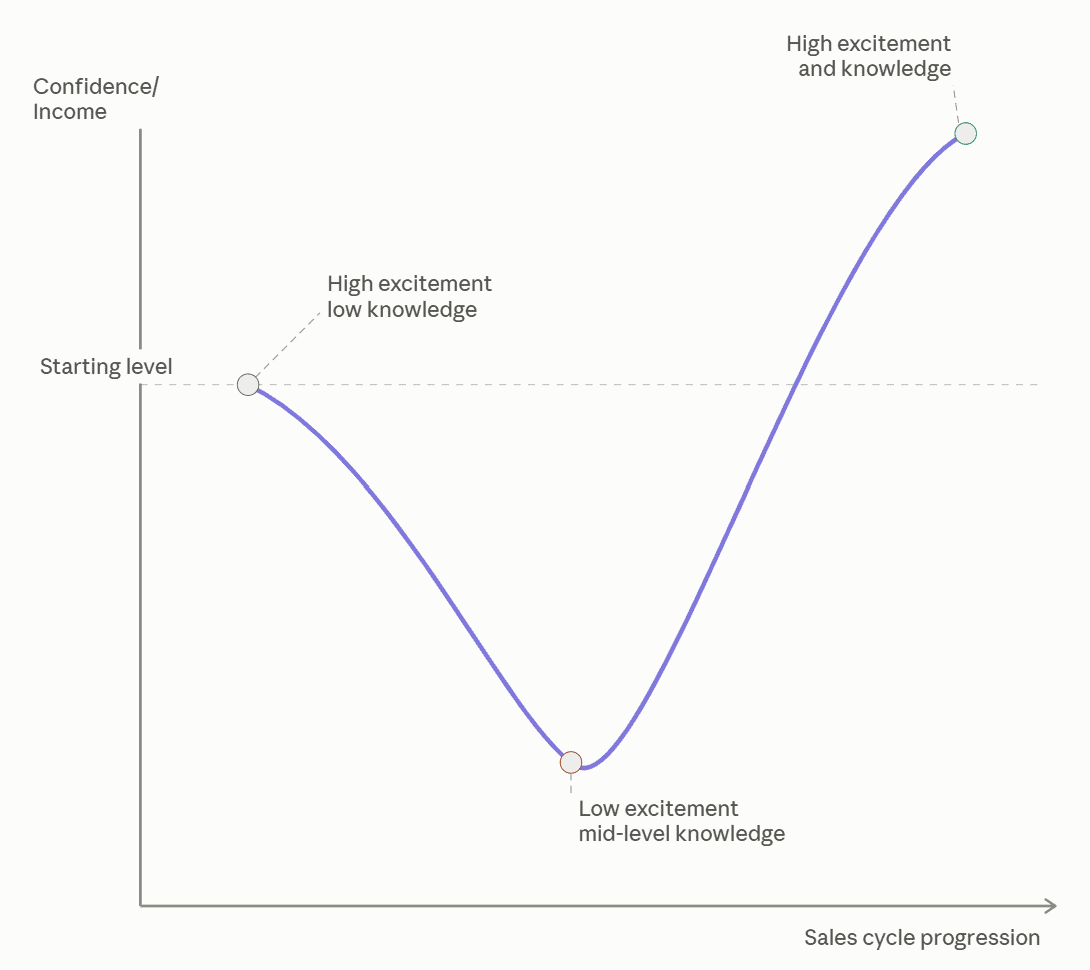
If you move along the curve you see the J represents the success, most often in terms of income. As the professional moves along the curve they go from naïve to experienced, and the desire to quit is generally highest at low excitement right before the magic happens. At this point, we need to assess what the hurdle is. Is it a fear thing? A time management thing? A skills thing? Or are we dealing with a company or a role that is completely out of alignment with the sales pro? All of these can be addressed one way or another. Often, resilience is the answer through execution of daily habits, and amazing careers are built. Not always, though.
Put Levitt’s data next to Godin’s framework and you get a fairly uncomfortable conclusion: most of us aren’t under-quitting. We’re under-deciding. We stay in the Dip and the Cul-de-Sac with equal stubbornness, because “never give up” doesn’t come with an instruction manual telling you which one you’re in.
THE POINT
Focus, resilience, and adaptability are needed. These aren’t three separate virtues competing for your attention — they’re a sequence. Focus keeps you from chasing every shiny distraction. Resilience gets you through the Dip, the part that’s supposed to be hard. Adaptability is what tells you, honestly, whether you’re still in a Dip or you’ve wandered into a Cul-de-Sac.
“Don’t ever give up” only works if you already know which one you’re standing in. Many never stop to check. That’s the real failure — not quitting too early, and not staying too long, but never asking the question in the first place.
So periodically, ask it. Straight up, no motivational quote required:
- Am I aligned with my Mission, Vision, and Principles?
- What’s actually working, where should I invest more time and resources?
- What isn’t working, and why — do I need to build a skill, build a system, delegate it, or just stop?
- What, specifically, am I going to do about the answer?
Persistence without a periodic assessment isn’t discipline. It’s just motion. And motion, as anyone who has stayed too long in the wrong Dip can tell you, is not the same thing as progress.
Want to go deeper?
I work with real estate professionals and leaders who are ready to build businesses worth owning. If you’re serious about implementing systems and habits that actually stick, let’s talk.
Email me: [email protected]
Or schedule time using the Calendar function here: Contact Us — Momentors Business and Life Coaching
Let’s go.